Roj Nemennuh Sarton
The Caves of SteelRoj Nemennuh Sarton is the murdered Spacer at the center of the investigation, but his significance extends beyond his death: he was developing humanlike robots as part of a Spacer-sponsored effort to bring human and robot society into closer integration. His murder turns that project into a point of political crisis and makes the question of who may investigate—and whose evidence can count—inseparable from the search for the killer.
Identity and Work
Sarton was a citizen of Aurora and a resident of Spacetown. The Commissioner had arranged to meet him on the day the news of his death emerged; the appointment was so close that the Commissioner believed he would have discovered the body himself had he arrived five minutes earlier. Their planned meeting places Sarton not merely in the background of a public controversy but in direct contact with the local police leadership.
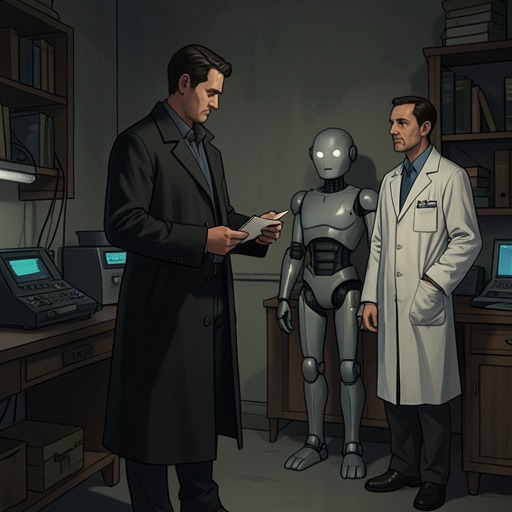
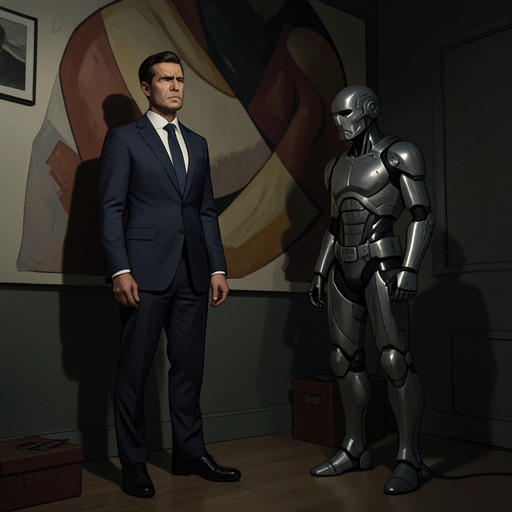
Sarton had spent a year working on the design and construction of robots with human externals. R. Daneel Olivaw identifies himself as the first such robot and, so far, the only one. His humanlike appearance was not incidental: it was intended to help Earthmen accept him and allow him closer access to human life. Daneel’s education was incomplete when Sarton was killed, and the murder forced him prematurely into his assigned role. Through this unfinished creation, Sarton’s work remains active in the investigation even though Sarton himself cannot explain it.
Murder and Investigation
The Commissioner tells Elijah Baley that Sarton died three days before their conversation. The death is identified as murder: someone had used a blaster, and the Commissioner describes the fatal result as a missing chest. The blunt revelation interrupts Baley’s earlier sarcastic response to the news that a Spacer had died and fixes the case’s central fact: the victim was not lost to illness but deliberately killed.
Sarton’s murder is treated by the Spacers as potentially connected to recent attempts to sabotage their project of creating an integrated human-and-robot society on the Outer Worlds model. They suspect it may be the work of an organized terrorist group rather than an isolated attack. At this point, however, the account establishes their interpretation as a suspicion, not a demonstrated explanation of Sarton’s death. The distinction matters: the murder immediately acquires a political meaning, but the investigation must still determine what actually happened.
Jurisdiction and Political Stakes
The case sits across competing claims of authority. The Commissioner has consulted the Mayor, visited Spacetown, and spoken in Washington with the Terrestrial Bureau of Investigation. The Bureau’s position is that the matter falls to the city because Spacetown lies within New York’s limits, while Baley points out that the Spacers also possess extraterritorial rights. The local location of the crime therefore does not settle who can investigate or control the account of it.
The Commissioner warns that the Spacers can insist on their own investigation and send whatever report they choose to their home governments. The Outer Worlds might then use the case to impose indemnity charges on Earth. Paying could be politically disastrous for the government; refusing could bring another kind of disaster. Sarton’s death thus places the investigation under diplomatic pressure before its facts are resolved: a finding about one murder could affect the relations between Earth and the Outer Worlds.
Sarton’s Double and the Case’s Reversal
The investigation later introduces a staged account of the apparent crime. In Dr. Han Fastolfe’s explanation, R. Daneel Olivaw was made to impersonate Sarton in a false murder, after which Sarton was to impersonate Daneel in the false investigation of that false murder. The account reveals how the case’s central identities and apparent evidence could be manipulated. The publicly reported killing is not a straightforward record of Sarton’s death; the supposed victim and the actual Sarton have been made part of a deliberate deception.
Fastolfe argues that the Commissioner saw what he believed to be Sarton’s corpse and that the Commissioner had witnessed Daneel under construction, which he uses to support the claim that only one Daneel existed. Baley counters that the Commissioner is not a robotics expert and could not rule out other humanlike robots. The dispute makes the evidentiary problem concrete: a witness’s identification, even when sincere, may not establish which body or machine was present.
Evidence, Status, and Narrative Significance
Daneel’s ability to remember two faces is offered as a possible line of evidence, but Baley points out that Daneel’s testimony would have no standing in an Earth court once he identified himself as a robot. The obstacle is not simply whether Daneel knows what he saw; it is whether the legal system recognizes a robot as a witness at all. The investigation therefore exposes a gap between the humanlike capacities Sarton designed into Daneel and the legal status assigned to him by Earth.
Sarton’s role persists through these contradictions. His murder initiates the case, his robotics work supplies the means for a false identity, and the attempted reconstruction of events makes his own place in the story uncertain. The case binds private violence to public power: a death within New York’s jurisdiction becomes a dispute over Spacer rights, possible compensation, the credibility of robotic evidence, and the political future of human–robot integration. Sarton’s absence is consequently not a blank at the center of the plot but the condition that makes every competing account consequential.